
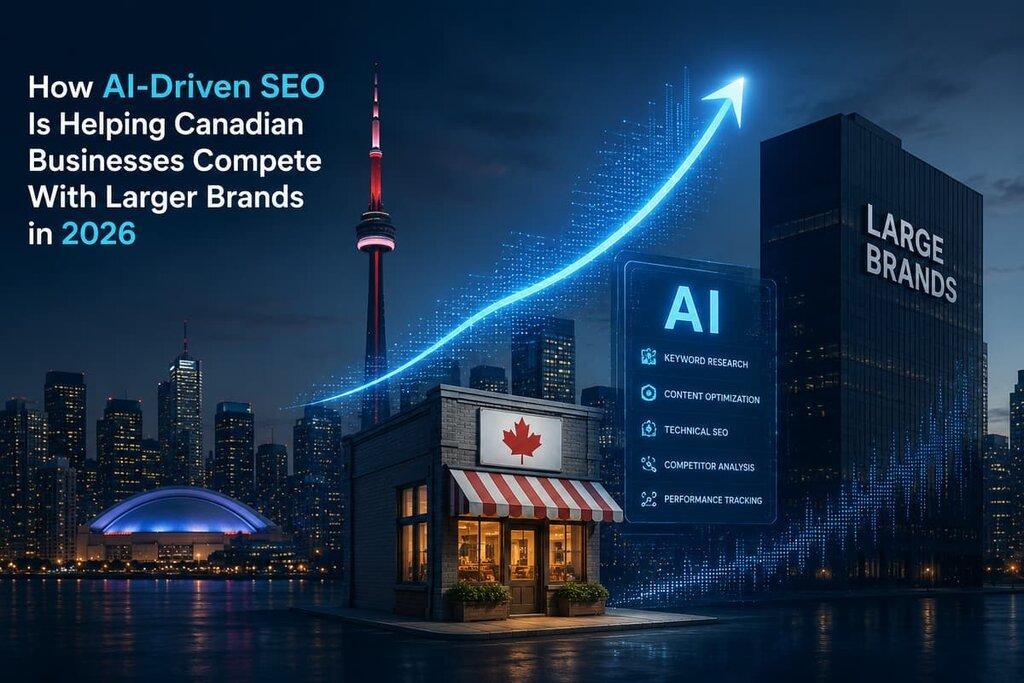
A few years ago, competing with a national brand on Google felt impossible for a small Canadian business. The enterprise had a team of twenty marketers, a six-figure monthly ad budget, and thousands of backlinks built over a decade. The local shop had a WordPress site, a Yelp page, and hope.
That gap has not disappeared in 2026, but it has narrowed — significantly. The reason is not that small businesses suddenly found bigger budgets. It is that artificial intelligence has made the most time-consuming, expertise-intensive parts of SEO accessible to companies that could never have afforded them before.
The shift is not theoretical. It is already reshaping how Canadian businesses show up in search results, how they create content, and how they make decisions about where to invest their limited marketing dollars.
What AI-Driven SEO Actually Means
The term gets thrown around loosely, so it is worth defining. AI-driven SEO does not mean plugging a keyword into ChatGPT and publishing whatever comes out. That approach was already outdated by mid-2024, and Google’s helpful content updates have made it actively counterproductive.
What it does mean is using machine learning and natural language processing tools to handle the analytical and structural work that traditionally required either deep technical expertise or hundreds of manual hours. This includes tasks like identifying content gaps by analyzing competitor pages at scale, clustering thousands of keywords into topic groups based on search intent rather than just volume, generating technical audit recommendations by crawling a site and flagging issues in priority order, and predicting which content topics have the highest probability of ranking based on current SERP composition.
The content itself still needs human judgment, brand voice, and genuine expertise. But the infrastructure around it — the research, the prioritization, the technical optimization — is where AI has created the biggest leverage for smaller teams.
Why This Matters More in Canada
The Canadian market has a few characteristics that make AI-driven SEO particularly impactful here. First, the country’s economy is heavily weighted toward small and medium-sized businesses. According to Innovation, Science and Economic Development Canada, SMEs account for over 98 percent of all businesses in the country. Most of them serve local or regional markets, which means their search competition is geographically bounded — and therefore winnable with the right strategy.
Second, many Canadian industries are still in the early stages of SEO maturity. Outside of a few highly competitive verticals like real estate, immigration law, and financial services, the content quality bar in local search results is often surprisingly low. A business that invests in well-researched, properly structured content can leapfrog competitors who have been online longer but never optimized for search.
Third, Canada’s bilingual market creates opportunities that most businesses ignore entirely. A company that publishes optimized content in both English and French effectively doubles its addressable search audience in provinces like Ontario, New Brunswick, and Quebec — a move that AI translation and localization tools have made far more practical than it was even two years ago.
Where the Real Advantage Shows Up
Local Search and the Map Pack
For businesses serving a specific geographic area, local SEO remains the highest-ROI channel available. And AI is making it dramatically more efficient. Tools can now monitor Google Business Profile performance, track local keyword rankings across multiple locations, identify review sentiment patterns, and generate location-specific content at a pace that would have required a dedicated team just a few years ago.
The Map Pack — the group of three businesses that appears with a map at the top of local search results — is where most of the action is for service-area businesses. Getting into that top three requires a combination of proximity, relevance, and prominence. AI tools help with the last two by analyzing what the current top-ranking businesses have in common and reverse-engineering the signals that Google values most in each specific market.

Content Strategy at Scale
One of the biggest challenges for small businesses has always been content production. Knowing what to write, how to structure it, and how to make it better than what already ranks is a skill set that takes years to develop. AI does not replace that skill set, but it compresses the learning curve.
A well-configured AI workflow can analyze the top-ranking pages for a target keyword, identify the subtopics they cover, flag the questions searchers are asking (via People Also Ask data and related searches), and produce a structured brief — all before a human writes a single word. The result is content that is strategically sound from the start, rather than content that needs to be retrofitted after the fact.
Technical SEO and Site Health
Technical SEO — the behind-the-scenes work of ensuring a website is crawlable, fast, secure, and properly structured — has historically been a black box for non-technical business owners. AI-powered crawling tools have changed that. They can audit a site with thousands of pages in minutes, prioritize issues by estimated impact, and in some cases generate the code needed to fix them.
For Canadian businesses running on platforms like WordPress, Shopify, or Wix, these tools can identify problems like missing alt text, duplicate title tags, broken internal links, and slow-loading pages — issues that silently erode search performance over time.
The Human Element Still Matters
It would be a mistake to suggest that AI can replace experienced SEO professionals. It cannot. What it can do is amplify the effectiveness of the people and agencies who know how to use it.
The businesses seeing the best results in 2026 are the ones pairing AI tools with human strategic oversight. They use automation for data collection and pattern recognition, but rely on experienced professionals for interpretation, creative direction, and client-specific judgment. Mehrana Agency, a Toronto-based digital marketing firm specializing in SEO for Canadian businesses, is one example of this approach in practice. Their team combines AI-powered keyword research and competitor analysis with hands-on content strategy and local market expertise — the kind of hybrid workflow that consistently outperforms either pure automation or purely manual methods.
This distinction matters because the market is now flooded with AI-generated content that lacks depth, accuracy, or any connection to the actual business behind it. Google has gotten increasingly sophisticated at identifying and devaluing this type of content. The businesses that will maintain and grow their search visibility are the ones producing content that is both strategically optimized and genuinely useful — a combination that requires human skill even in an age of powerful AI.

What Canadian Business Owners Should Do Now
If you run a business in Canada and have not yet incorporated AI into your SEO workflow, the window of early-mover advantage is still open — but it is closing. Here is a practical starting point:
Audit your current search visibility. Use free tools like Google Search Console to understand which queries bring traffic to your site, which pages perform best, and where you are losing ground. This baseline data is essential before making any changes.
Identify your content gaps. Look at what your top three competitors are ranking for that you are not. AI-powered tools like Ahrefs, Semrush, or SurferSEO can generate this comparison in minutes. Focus on the gaps where you have genuine expertise to offer — not just keyword volume.
Invest in structured, strategic content. Every page on your site should target a specific search intent and be structured to answer the searcher’s question better than what currently ranks. AI can help you build the brief, but the content itself should reflect your actual knowledge and experience.
Do not ignore local SEO. If you serve a specific city or region, your Google Business Profile is as important as your website. Keep it updated, respond to reviews, post regularly, and make sure your NAP (name, address, phone) information is consistent everywhere it appears online.
Consider working with specialists. The most effective AI-driven SEO strategies are not the ones run entirely by software. They are the ones designed and monitored by professionals who understand both the technology and the market. Whether you build that capability in-house or work with an agency, the combination of human expertise and AI tools is where the real results come from.
The Playing Field Is Shifting
The story of AI in SEO is not about robots replacing marketers. It is about removing the barriers that kept small and mid-size businesses from competing effectively in organic search. Data that used to require expensive enterprise subscriptions is now available through affordable AI tools. Analysis that used to take weeks can be done in hours. Content strategies that used to require a team of specialists can now be executed by a lean operation with the right workflow.
For Canadian businesses willing to lean into this shift, the opportunity is real and measurable. The ones who act on it now will be building compounding advantages in search visibility, brand authority, and customer acquisition — while their competitors are still debating whether AI is worth the investment.
The answer to that question, for anyone still wondering, is already on the first page of Google.
Frequently Asked Questions
What is AI-driven SEO?
AI-driven SEO uses machine learning and natural language processing to automate data-heavy tasks like keyword research, competitor analysis, content gap identification, and technical auditing. The content creation and strategic decisions still require human expertise, but AI handles the analytical groundwork far faster and more accurately than manual methods.
Is AI-generated content good enough for SEO?
Not on its own. Google’s algorithms have become adept at identifying low-quality AI-generated content and filtering it out of top results. The most effective approach is using AI for research and structure while ensuring the final content reflects genuine expertise and provides real value to the reader.
How much does AI-driven SEO cost for a small business?
Costs vary widely. Basic AI tools like Google Search Console and free-tier versions of Ahrefs or Semrush can get you started at no cost. Professional AI-assisted SEO services from agencies typically range from a few hundred to a few thousand dollars per month, depending on the scope and competitiveness of the market.
How long does it take to see results from SEO?
Most SEO strategies take three to six months to produce noticeable improvements in search rankings and traffic. AI tools can accelerate the research and implementation phases, but the timeline for Google to recognize and reward optimized content remains largely the same.
Do Canadian businesses need different SEO strategies than American ones?
In many cases, yes. Canada’s bilingual market, different consumer search patterns, and more localized business landscape all influence keyword targeting and content strategy. Businesses serving the Canadian market benefit from SEO strategies tailored to Canadian search behaviour and geographic competition.