

Introduction
Nine field-tested practices for planning sources, sampling edge cases, tracking consent, and measuring label quality — with checklists, cost numbers, and examples from vision, speech, and document AI.
Most enterprise AI projects don’t stall because someone picked the wrong architecture. They stall because a dataset lands in the repo that nobody can explain three months later — where it came from, who approved it, why half the samples look nothing like production. Teams that avoid this treat data work as engineering, not procurement. They can tell you which device recorded each sample, who consented to it, and what question it was meant to answer.
That discipline looks the same whether a bank is mining five years of call transcripts or a robotics group is running egocentric data collection with head-mounted rigs on a warehouse floor. Below are nine practices you can apply to your next project, plus a look at where the money actually goes. None of it requires a research lab — a team of four can run all of it.
What enterprise AI data collection actually involves
Enterprise AI data collection is the full process of deciding what data a model needs, getting it legally, labeling it consistently, and keeping it fresh after launch. It is broader than “downloading a dataset.” A public benchmark arrives clean, static, and permission-free. Enterprise data arrives messy, keeps changing, and carries obligations — contracts, privacy law, customer trust.
Those obligations are also why copying academic habits backfires. Researchers optimize for a leaderboard. You are optimizing for a system that has to keep working on a Tuesday in production, on inputs nobody anticipated, while an auditor asks where each record came from.
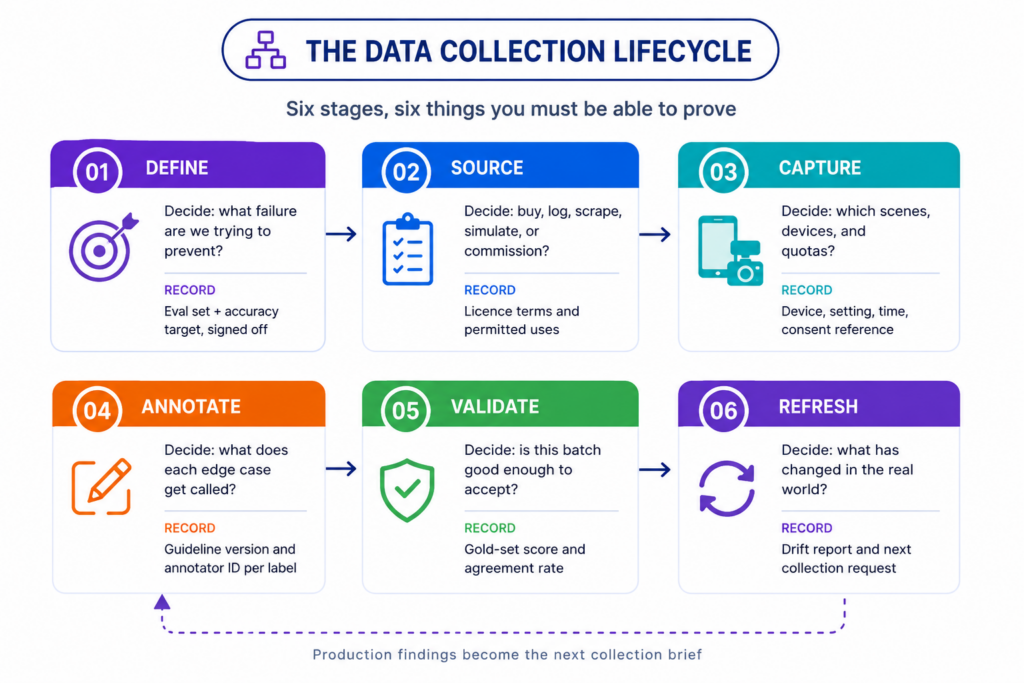 1. Write the evaluation set before you collect anything
Start at the end. Before a single file is gathered, write down how you will know the model works: which examples it must get right, and what score counts as a pass. Then build that evaluation set by hand, from real cases.
A claims team at an insurer did this for a photo-based damage classifier. They pulled 400 past claims, including 60 disputed ones, and had two adjusters agree on the correct answer for each. That eval set became the spec. When a vendor later offered 200,000 stock images of damaged cars, the team tested against those 400 cases and found the stock photos improved nothing — the model already handled clean daylight shots. What it failed on were dashboard glare and photos taken at night in a parking garage. The eval set turned a $60,000 purchase into a targeted, much cheaper capture job.
2. Choose sources on purpose, not by convenience
Every source type buys you something and costs you something. The mistake is defaulting to whichever one is easiest to access this quarter. Public data is free but shared with your competitors. Production logs are cheap and perfectly on-distribution, but they only contain what already happens — never the scenario you’re trying to support next year.
|
Source |
Relative cost |
Time to first batch |
Legal exposure |
Best used for |
|
Public / open datasets |
Very low |
Days |
Low, if licences checked |
Pre-training, baselines, sanity checks |
|
Licensed third-party |
Medium |
2–8 weeks |
Low (contractual) |
Filling a known gap fast |
|
Web-scraped |
Low |
1–3 weeks |
High |
Rarely worth it for regulated work |
|
Production logs |
Low |
Days, if logging exists |
Medium (consent scope) |
Matching real usage exactly |
|
Synthetic / simulated |
Low–medium |
2–6 weeks |
Low |
Rare events, privacy-blocked cases |
|
Commissioned capture |
High |
4–12 weeks |
Low, with proper consent |
Anything that doesn’t exist yet |
Table 1. Source trade-offs. “Relative cost” is per usable labeled unit, not per raw file — a cheap source with a 30% reject rate is not cheap.
Most mature programs end up blending three or four of these. A voice assistant team might pre-train on open speech corpora, license accented speech to close a gap, and commission fresh recordings for the specific noise conditions its customers work in.
3. Sample for the tail, not the average
Real usage is lopsided. Collect naturally and you’ll get 10,000 examples of the easy case and eleven of the cases that generate complaints. Set explicit quotas instead.
Write a sampling plan as a grid. For a document-processing model, the axes might be document type, scan quality, and language. For a wearable-camera project, they might be lighting, motion speed, and hand occlusion. Then assign a minimum count per cell — say 300 — and treat any cell below quota as an open ticket. This is dull work, and it is the single highest-leverage hour you will spend.
Two warnings. Don’t rebalance by duplicating rare samples; you’ll teach the model those specific frames, not the concept. And keep the natural distribution in a separate held-out slice, so you can still measure real-world performance after over-sampling the tail for training.
4. Attach consent and licence to the record, not to a contract folder
The question that sinks projects at audit time is simple: “Show me permission for this specific file.” If the answer lives in a signed PDF on someone’s laptop, you have a problem. Permission has to travel with the data.
Store these fields alongside every sample, from day one:
- Source ID — which vendor, system, or session produced it
- Licence or consent reference — pointing to a specific document and version
- Permitted use — training only, evaluation only, internal only, commercial
- Expiry or withdrawal status — so removal requests are a query, not an archaeology project
- Capture context — device, location type, date
The NIST AI Risk Management Framework is a useful, non-legalistic reference for structuring this. It won’t tell you what your jurisdiction requires, but it gives you vocabulary your legal and security teams already recognize — which makes approvals faster.
5. Treat annotation guidelines as a product, not a memo
Annotators aren’t inconsistent because they’re careless. They’re inconsistent because the instructions left a real question unanswered, and forty people answered it forty ways.
Good guidelines have three parts: a one-line definition per label, at least three positive and three negative examples per label, and an explicit rule for every ambiguity someone has raised. That last part matters most. Keep a running “edge case log” — a table of every question annotators asked and the ruling you gave. In one retail shelf-monitoring project, 60% of disagreements traced back to a single unanswered question: does a partially hidden product count as present? One line of guidance fixed it.
Version the guidelines like code, and stamp each label with the version used. Otherwise a change in month four silently contaminates everything from months one to three.
6. Measure label quality with numbers
“The labels look fine” is not a measurement. Even famous benchmark datasets aren’t clean: researchers using confident learning found an average of roughly 3.4% label errors across ten widely used ML test sets, including about 6% of the ImageNet validation set. Your internal data, labeled under deadline, is unlikely to be better.
|
Check |
What it tells you |
Healthy range |
What to do when it slips |
|
Gold-set accuracy |
Whether annotators match a known-correct sample |
≥ 95% |
Retrain the individual; don’t reject the batch yet |
|
Inter-annotator agreement (Cohen’s kappa) |
Whether the task itself is well defined |
≥ 0.75 |
Fix the guidelines — this is rarely a people problem |
|
Review pass rate |
How much rework the batch needs |
≥ 90% |
Pause intake and re-run onboarding |
|
Class balance drift |
Whether incoming data still resembles the plan |
±10% of quota |
Adjust collection targets, not labels |
|
Duplicate / near-duplicate rate |
Hidden leakage between train and test |
< 1% |
De-duplicate before splitting, always |
Table 2. A minimum quality dashboard. Run these per batch, not once at the end.
Salt every batch with 2–5% gold questions — items where you already know the right answer. It’s the cheapest quality signal available, and it works whether the labeling happens in-house or through a vendor.
7. Version data the way you version code
If you can’t reproduce a model, you can’t debug it. That means every training run should point to an immutable dataset snapshot with an ID.
Three habits cover most of it. First, never overwrite — new data creates a new version. Second, keep a manifest: a file listing every sample ID, its label, its source, and its guideline version. Third, write a short dataset card for each release: what’s in it, how it was collected, what it’s not suitable for, and known gaps. A page is enough. When a model behaves strangely eight months later, that page is what saves the week.
8. Budget for the real cost curve
Data problems get more expensive the longer they survive, and they get more expensive in jumps rather than inches. Fixing a label definition while you are writing the spec costs a conversation. Fixing it after 200,000 samples are labeled costs a re-labeling contract. Fixing it after the model is live can cost a rollback, customer trust, and a conversation with your auditor. Quality management has a name for that escalation — the 1:10:100 rule.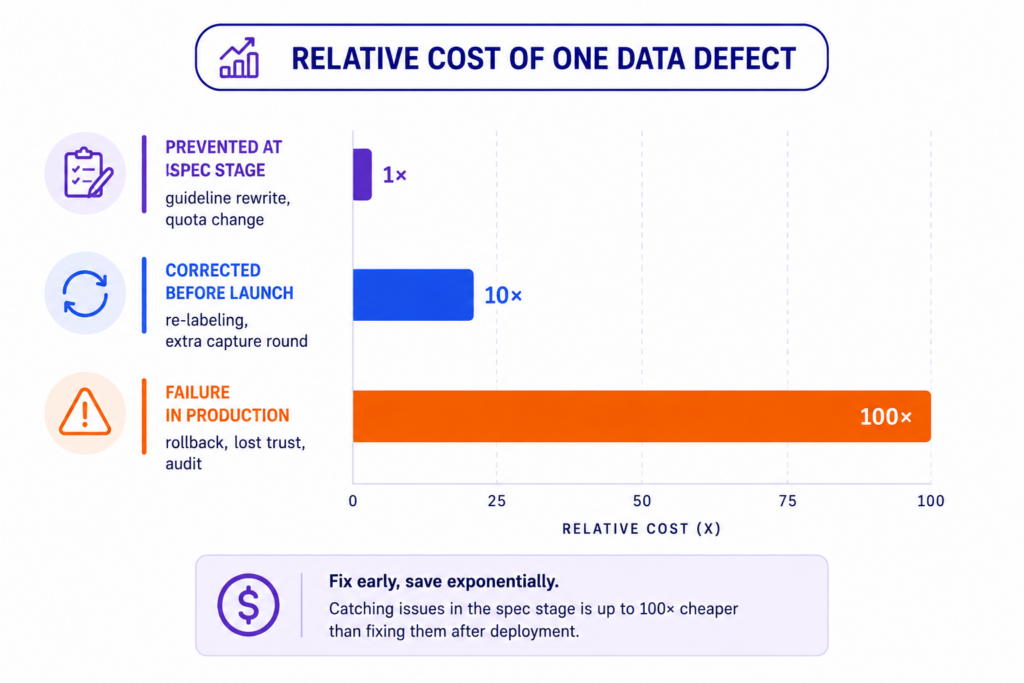 Figure 2. The 1:10:100 rule of data quality, first set out by George Labovitz and Yu Sang Chang in Making Quality Work (1992), applied to an AI data pipeline. The multipliers are an order-of-magnitude rule of thumb rather than measured costs — the point is the shape, not the arithmetic.
This escalation is also why data problems stay invisible until they are costly. A study of AI practitioners in health, conservation, and finance settings coined the term data cascades for exactly this pattern: small upstream data decisions that compound downstream, showing up late and expensively. The researchers found 92% of practitioners had experienced at least one, with roughly 45% reporting two or more on a single project.
Practical version: allocate 15–20% of your data budget to quality checks and re-collection before you need them. Teams that skip this don’t save money — they move the spending down to the bottom bar of the chart.
9. Close the loop after launch
Collection isn’t a phase that ends. The world moves: a new device ships, a competitor changes its packaging, customers start typing queries in a way nobody predicted.
Build three feedback paths from day one. Log low-confidence predictions automatically and route a sample of them into the labeling queue each week. Give support and operations staff a one-click way to flag a wrong answer, and make sure that flag carries the input with it. Then compare live input statistics against your training distribution monthly — if a segment moves more than 10%, schedule a collection round.
A logistics company monitoring parcel-label reading found accuracy dropping in one region. The cause wasn’t the model. A carrier had switched to a glossier label stock that reflected the scanner light. Two weeks of targeted capture on the new stock fixed it. Without the feedback loop, they’d have spent a quarter tuning hyperparameters.
Your first 30 days
- Days 1–5: write the eval set. 200–400 real cases, agreed by two domain experts.
- Days 6–10: build the sampling grid and set per-cell quotas.
- Days 11–15: choose sources using Table 1, and define the metadata fields every sample must carry.
- Days 16–22: label 500 samples as a pilot. Measure agreement. Rewrite the guidelines using what breaks.
- Days 23–30: scale up, with gold questions in every batch and a versioned snapshot at the end.
The pilot step is the one teams skip, and it’s the one that pays. Five hundred samples will expose almost every guideline flaw you’d otherwise discover at sample 50,000.
Conclusion
Good enterprise AI data collection isn’t glamorous. It’s quotas, metadata fields, edge-case logs, and a dataset card nobody reads until the day everybody needs it. But the difference between a model that ships and one that quietly dies in review is almost never the architecture — it’s whether someone could explain the data.
Pick two practices from this list and apply them to the project on your desk right now. Start with the eval set and the gold questions; they cost the least and catch the most. Everything else gets easier once those two are running.