
If you’re building an IoT product, choosing the right SIM card is more important than it might seem.
A reliable IoT SIM helps keep your devices connected, whether they’re in one city or spread across the world. It should also make it easy to manage your devices, control costs, and grow your deployment as your business expands.
There are plenty of IoT SIM providers out there, but they don’t all offer the same coverage, pricing, or management tools.
To help you compare your options, we’ve picked three providers that stand out in 2026: Telnyx, emnify, and Hologram.
What Should You Look for in an IoT SIM?
The best IoT SIM for one business might not be the best for another.
For example, if your devices stay in one country, you probably don’t need the same level of global coverage as a company tracking fleets across several continents.
That’s why it’s worth looking at a few things before choosing a provider, including:
- Coverage
- Pricing
- eSIM support
- Device management
- APIs
- Security
With that in mind, let’s look at three providers that are worth considering.
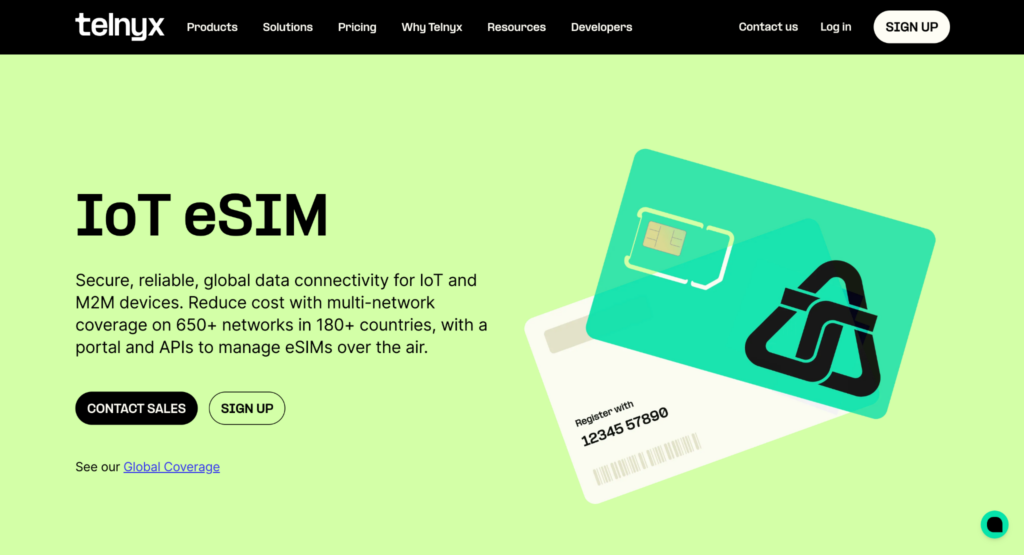
Telnyx
At a Glance
|
Best for |
Global IoT deployments |
|
Coverage |
650+ networks in 180+ countries |
|
SIM types |
Physical SIM, MFF2, eSIM |
|
Starting price |
From $0.01 per MB |
Why We Picked It
If you’re looking for IoT SIM cards, Telnyx is one of the easiest providers to recommend.
Instead of dealing with multiple mobile carriers, you get one IoT SIM that works across 650+ networks in more than 180 countries. That makes rolling out devices in different regions much simpler.
We also like that Telnyx gives you different SIM options. You can choose a standard SIM card, an embedded MFF2 SIM, or an eSIM, depending on your device. Since the platform supports remote SIM provisioning, you can update SIM profiles over the air without replacing the hardware.
What Stands Out
One of Telnyx’s biggest strengths is how easy it is to manage devices. Everything can be done from one dashboard, and if you prefer to automate things, there are APIs for that too. Whether you’re managing ten devices or ten thousand, everything stays in one place.
The pricing is another plus. It starts at $0.01 per MB, with no minimum order quantities or fixed monthly data commitments. For businesses that want to keep costs predictable, that’s a nice advantage.
On top of that, features like automatic network switching and private networking help keep devices connected, even if one carrier isn’t available.
Is It Right for You?
If you’re planning to deploy devices in different countries or expect your project to grow over time, Telnyx is a great option. It combines broad global coverage, flexible pricing, and simple device management, making it suitable for both small projects and large deployments.
emnify
At a Glance
|
Best for |
Large IoT deployments |
|
Coverage |
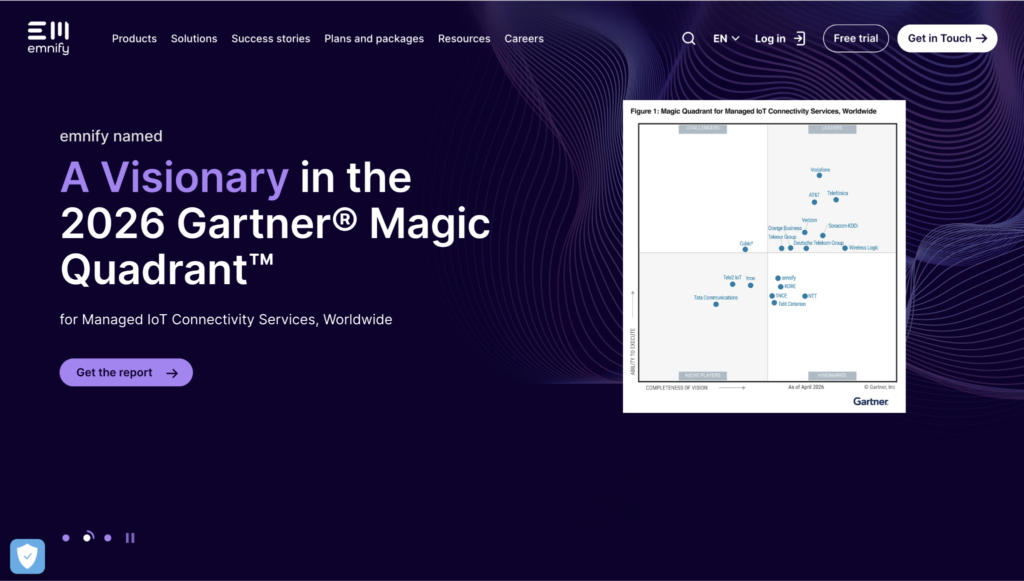
540+ networks in 190+ countries |
|
SIM types |
Physical SIM, MFF2, eSIM |
|
Pricing |
Custom pricing |
Why We Picked It
emnify is a good choice for businesses that want more control over their IoT connectivity.
Like Telnyx, it offers global coverage through hundreds of mobile networks. But where emnify really stands out is its management platform. It gives you detailed control over your SIMs and devices, making it easier to manage large deployments from one place.
What Stands Out
The platform lets you activate SIMs, monitor data usage, create rules, and automate tasks through its APIs. It also supports remote SIM management, so you can update eSIM profiles without physically accessing the device.
Another feature we like is the amount of control you have. You can set data limits, pause SIMs, and even lock them to specific devices to help prevent misuse.
Unlike Telnyx, emnify doesn’t publish simple pay-as-you-go pricing. Instead, pricing is based on your project and the services you need.
Is It Right for You?
If you’re managing hundreds or thousands of connected devices and want detailed control over your connectivity, emnify is a great choice. For smaller projects, though, providers with simpler pricing may be easier to get started with.
Hologram
At a Glance
|
Best for |
Developers and smaller IoT projects |
|
Coverage |
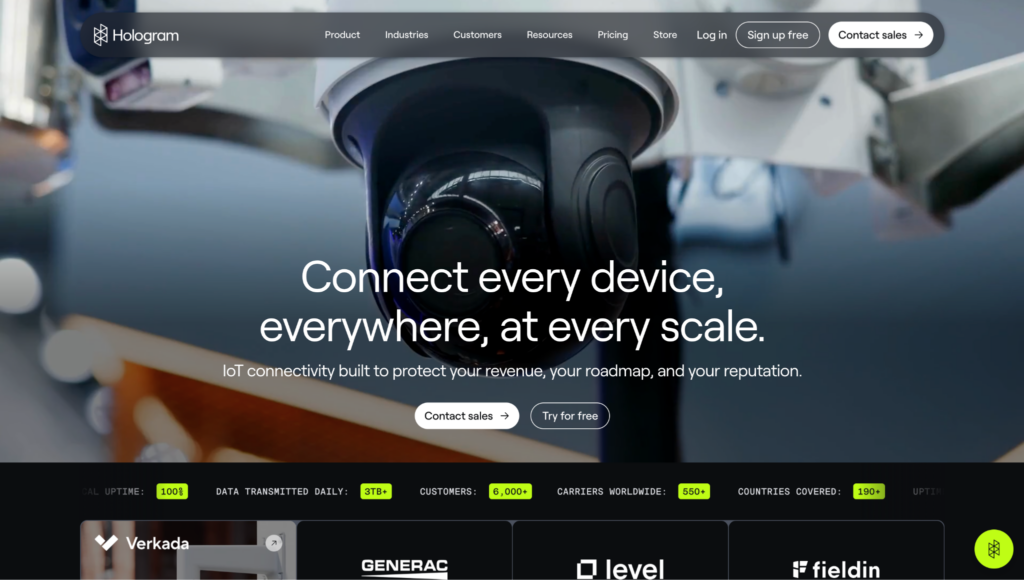
550+ networks in 190+ countries and territories |
|
SIM types |
Physical SIM and eSIM |
|
Pricing |
Pay-as-you-go and monthly plans |
Why We Picked It
If you’re looking for an IoT SIM that’s easy to get started with, Hologram is a great option.
It’s especially popular with developers and startups because the platform is straightforward to use. Setting up devices is simple, and you get access to a clean dashboard and APIs that make managing your SIMs much easier.
Like the other providers on this list, Hologram offers global coverage, so it’s a good choice if your devices need to work in different countries.
What Stands Out
What we like about Hologram is how easy it is to test new projects. You don’t need to commit to a large deployment right away, so it’s well-suited for prototypes and smaller rollouts.
The platform also includes tools for monitoring data usage, managing devices remotely, and receiving alerts if something isn’t working as expected.
As your project grows, Hologram can scale with you, although businesses with very large deployments may eventually want more advanced network management features.
Is It Right for You?
If you’re building your first IoT product or want a platform that’s simple to set up and manage, Hologram is a great place to start. It’s beginner-friendly while still offering enough flexibility for growing projects.
Conclusion
There isn’t one IoT SIM that’s perfect for every business, but these three providers are among the strongest options available today.
If we had to choose one overall, Telnyx would be our pick because it offers a great mix of global coverage, flexible pricing, and tools that make managing devices much easier.
That said, emnify is better suited to businesses that need more advanced connectivity controls, while Hologram is a great option for developers and smaller projects.
The best choice ultimately comes down to your devices, your budget, and where you plan to deploy them.