
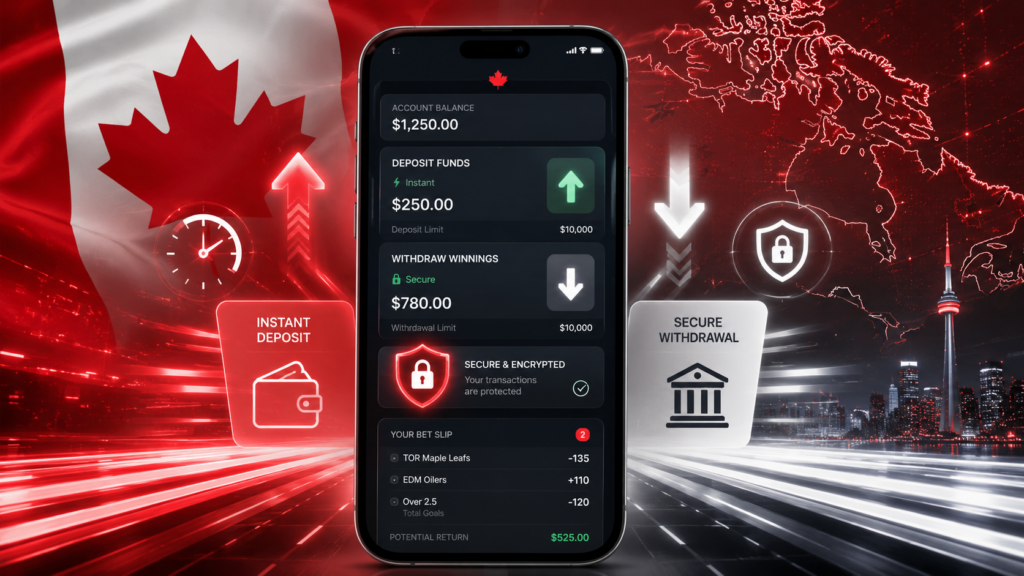
The Money Moves Faster Than the Match Clock
Ask any Canadian bettor what annoys them most about online betting, and it’s rarely the odds. It’s the wait. Waiting three days for a withdrawal while the match you bet on is already old news – that’s the real friction point. Payment speed has quietly become the feature players judge platforms by, sometimes more than the sportsbook lineup itself.
That shift didn’t happen overnight. It’s the product of a few converging forces: Canadian banks tightening fraud controls, players expecting Amazon-level instant everything, and regulators pushing operators toward transparency. The result is a payment landscape that looks almost nothing like it did five years ago – and it’s worth understanding why.
Why Interac Still Runs the Show
Any conversation about Canadian iGaming payments starts with Interac e-Transfer. It’s not flashy, it’s not new, but it’s the backbone of how money moves in and out of Canadian betting accounts. Banks trust it, players already have it set up, and it settles fast enough that most deposits clear in minutes rather than hours.
To choose a bookmaker that actually handles payments well, it helps to check platform reviews such as https://parimatch-canada.org/ before signing up – most pair Interac e-Transfer with e-wallets like Skrill or Neteller, so players aren’t forced to pick one system and stick with it. The logic is simple: fewer friction points at deposit means fewer abandoned sign-ups.
That said, e-Transfer isn’t perfect. Withdrawal caps, occasional bank-side delays, and manual verification steps still slow things down more than players would like. Which is exactly why operators are layering on alternatives rather than replacing it outright.
What’s Actually Changed on the Withdrawal Side
Deposits were never really the problem – it’s getting money out that used to be the headache. A few concrete shifts have narrowed that gap:
None of this is glamorous. But stacked together, it’s the difference between a three-day wait and same-day cash-out – which, for a lot of bettors, is the entire experience.
The Regulatory Layer Nobody Talks About Enough
Ontario’s regulated market – overseen by iGaming Ontario – changed the payment conversation in a less obvious way. Once operators had to hold formal licenses to serve the province, payment processing stopped being purely a UX decision and became a compliance one too. Licensed platforms have to document transaction trails, verify player identity before certain payout thresholds, and report suspicious activity patterns.
That sounds like bureaucracy, and partly it is. But it’s also why players in a regulated market can generally trust that a withdrawal request won’t just vanish into a support ticket black hole. Compliance requirements forced operators to build payment infrastructure that’s auditable, which – almost as a side effect – made it more reliable for everyday users too.
Provinces outside Ontario’s model still vary in how tightly they regulate payment processing, which is part of why payment experience across Canadian betting sites isn’t uniform. A platform licensed and audited under a provincial framework tends to have tighter payout SLAs than one operating under a looser offshore license.
Mobile Wallets Are Quietly Taking Over
Here’s something that doesn’t get enough credit: mobile payment integration has done more for player retention than most marketing budgets. Apple Pay and Google Pay adoption among Canadian bettors has grown alongside general e-commerce trends – people simply expect to tap and go, whether they’re buying groceries or funding a bet slip.
Platforms slow to integrate these options aren’t necessarily losing players outright, but they’re losing the impulse deposit – the “let’s just top up ten bucks” moment that happens on a phone between other things. That’s a real cost, even if it’s hard to put a number on.
Crypto payments occupy a smaller, more contested corner of this picture. A handful of operators support it for speed and lower transaction friction, but adoption among mainstream Canadian bettors remains limited compared to e-Transfer and cards – it’s a niche option rather than a default one, at least for now.
Final Thoughts
Payment infrastructure isn’t the part of online betting anyone gets excited about – nobody brags to friends about a fast withdrawal the way they’d brag about a winning parlay. But it’s become the quiet dealbreaker. Platforms that get it right keep players; the ones that don’t lose them to a competitor with a smoother cash-out flow, regardless of odds or bonus structure.
For Canadian bettors, the practical takeaway is straightforward: check a platform’s payout timelines and licensing status before deposit size, not after. The flashiest sportsbook interface means little if the money gets stuck on the way out.