
Code-to-cloud security tools are becoming a core part of how teams protect software from the first commit through production. Many programs start with a strong cloud graph, then realize they still need native coverage for code, dependencies, infrastructure as code, secrets, containers, dynamic testing, and the fixes that follow.
These platforms can map cloud risk, catch issues earlier in the SDLC, and reduce the gap between a finding and a shipped fix. Not every Wiz alternative works the same way. Some stay closest to agentless CNAPP visibility, while others go deeper on containers, runtime, Microsoft estates, or full native code-to-cloud workflows.
The following comparison highlights 8 Wiz alternatives worth considering for deeper code-to-cloud security, along with their key features, best-fit use cases, and code-to-cloud strengths.
Top 8 Wiz Alternatives: Features and Code-to-Cloud Strength Reviewed
|
Platform |
Key Features |
Best for |
Code-to-cloud strength |
|
Aikido Security |
Native SAST, SCA, IaC, and secrets Container scanning DAST for apps and APIs Cloud posture coverage Remediation workflows with reviewable fixes IDE, PR, and CI workflow fit |
Teams that want native scanners and fixes in one platform |
Deep across code, containers, DAST, cloud posture, and remediation |
|
Orca Security |
Agentless SideScanning Multi-cloud CNAPP visibility Attack path and posture context Workload and configuration risk views |
Teams that want an agentless CNAPP closest to Wiz’s cloud model |
Strong on cloud posture and attack paths, lighter on native code remediation |
|
Prisma Cloud |
Broad CNAPP feature set Code, cloud, and workload coverage Identity and network oriented controls Enterprise Palo Alto ecosystem fit |
Enterprises consolidating on Palo Alto for code-to-runtime |
Broad CNAPP breadth from code-related checks through runtime controls |
|
CrowdStrike Falcon Cloud Security |
Cloud security inside Falcon Workload and container coverage Shared telemetry with endpoint security Operations fit for Falcon teams |
Organizations already standardized on CrowdStrike |
Strong cloud and workload coverage inside an endpoint-led stack |
|
Sysdig Secure |
Kubernetes and container runtime depth Falco-based runtime insight Cloud native workload security Pipeline and production controls |
Container and Kubernetes-first security teams |
Deepest on container runtime and Kubernetes production risk |
|
Lacework FortiCNAPP |
Behavioral anomaly detection Cloud and workload activity baselines CNAPP style visibility Fortinet-oriented stack fit |
Teams that want behavior-led cloud detection |
Strong on behavioral cloud activity, less on native SDLC remediation |
|
Microsoft Defender for Cloud |
Native Azure and Microsoft cloud fit Posture and workload recommendations Microsoft security ecosystem integration Cloud security operations for Azure estates |
Azure-centered organizations |
Strong Microsoft cloud posture, narrower as a full multi-tool code platform |
|
Aqua Security |
Container and cloud native security Image, pipeline, and runtime controls Kubernetes security focus Container supply chain coverage |
Teams prioritizing container supply chain and runtime |
Deep on container supply chain and runtime, narrower on full AppSec breadth |
1. Aikido Security
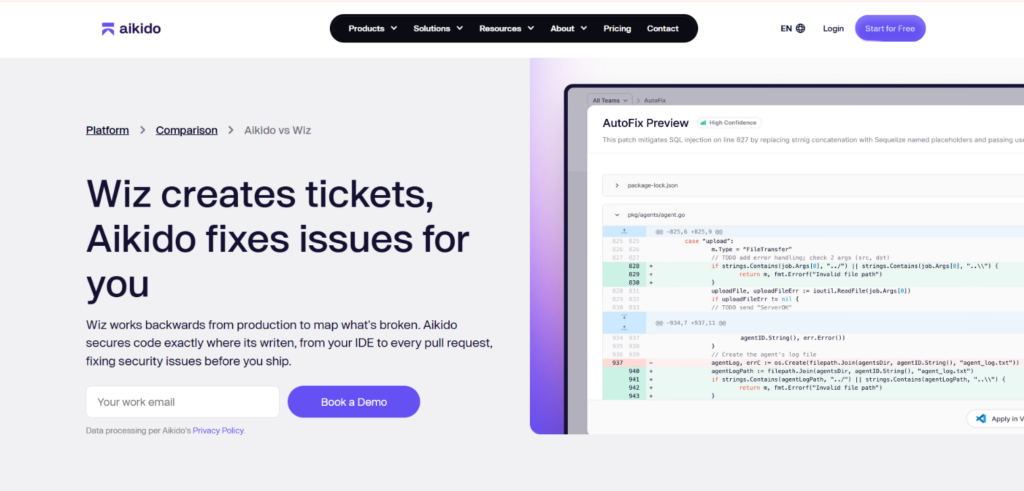
Aikido is a code-to-cloud security platform built for teams that want native coverage beyond a cloud-only graph. It brings SAST, SCA, IaC, secrets, containers, DAST, and cloud posture into one place, then supports remediation workflows that open reviewable fixes where engineers already work.
You can use it when Wiz-style cloud visibility is not enough on its own and you need deeper code security plus fixes in the same platform.
How it Helps Engineering Teams
Aikido’s code-to-cloud features reduce the manual work of jumping between separate SAST, SCA, cloud, and ticket tools. Findings show up in the IDE, pull requests, and CI, and remediation workflows help turn issues into reviewable fixes instead of another backlog item.
- Native SAST, SCA, IaC, and secrets coverage
- Container scanning
- DAST for apps and APIs
- Cloud posture coverage
- Remediation workflows with reviewable fixes
- IDE, PR, and CI workflow fit
Therefore, Aikido can be considered a strong Wiz alternative for engineering teams that need deeper code-to-cloud security with native scanners and remediation, not only production cloud mapping.
2. Orca Security
Orca Security is an agentless CNAPP platform and one of the closest cloud-security alternatives to Wiz. It uses SideScanning-style coverage across major clouds to surface posture, workload, and attack path context without putting agents on every host first.
How it Helps Engineering Teams
It gives engineering and security a fast cloud risk picture across AWS, Azure, and GCP, which helps teams prioritize exposed workloads and misconfigurations without a heavy agent rollout.
- Agentless SideScanning
- Multi-cloud CNAPP visibility
- Attack path and posture context
- Workload and configuration risk views
3. Prisma Cloud
Prisma Cloud from Palo Alto Networks is a broad CNAPP platform that stretches from code-related checks into cloud posture, workloads, and identity. Enterprises often evaluate it when they want one vendor story across a large security stack.
How it Helps Engineering Teams
It helps larger engineering and security programs consolidate many cloud and workload controls under one CNAPP, especially when the company already operates inside the Palo Alto ecosystem.
- Broad CNAPP feature set
- Code, cloud, and workload coverage
- Identity- and network-oriented controls
- Enterprise Palo Alto ecosystem fit
4. CrowdStrike Falcon Cloud Security
CrowdStrike Falcon Cloud Security extends the Falcon platform into cloud workloads and containers. The main draw is shared telemetry and operations for teams that already run Falcon on endpoints.
How it Helps Engineering Teams
It helps engineering organizations standardize cloud workload security on the same CrowdStrike operating model they already use for endpoints, which can reduce tool sprawl for Falcon-led teams.
- Cloud security inside Falcon
- Workload and container coverage
- Shared telemetry with endpoint security
- Operations fit for Falcon teams
5. Sysdig Secure
Sysdig Secure is a cloud native security platform with a deep Kubernetes and container runtime focus. Runtime insight, including Falco-based detection, is a major reason teams shortlist it when production workload behavior matters.
How it Helps Engineering Teams
It helps platform and engineering teams secure containerized services in Kubernetes with runtime context, so production behavior is part of the security loop rather than only static posture.
- Kubernetes and container runtime depth
- Falco-based runtime insight
- Cloud native workload security
- Pipeline and production controls
6. Lacework FortiCNAPP
Lacework FortiCNAPP is known for behavioral anomaly detection across cloud and workload activity. It baselines normal behavior and helps teams spot unusual patterns that static misconfiguration checks can miss.
How it Helps Engineering Teams
It helps security and engineering teams catch unusual activity in cloud environments, which is useful when the risk is not only a known CVE or a simple misconfiguration.
- Behavioral anomaly detection
- Cloud and workload activity baselines
- CNAPP-style visibility
- Fortinet-oriented stack fit
7. Microsoft Defender for Cloud
Microsoft Defender for Cloud is the natural alternative for Azure-centered organizations. It brings posture recommendations, workload security signals, and Microsoft ecosystem integration into one familiar cloud security layer.
How it Helps Engineering Teams
It helps Azure-heavy engineering teams get cloud posture and workload recommendations inside the Microsoft stack they already operate, without adding a separate multi-cloud CNAPP first.
- Native Azure and Microsoft cloud fit
- Posture and workload recommendations
- Microsoft security ecosystem integration
- Cloud security operations for Azure estates
8. Aqua Security
Aqua Security focuses on container and cloud native security across images, pipelines, and runtime. Teams often evaluate it when container supply chain and Kubernetes controls are the heart of the program.
How it Helps Engineering Teams
It helps engineering teams secure container delivery from image build through runtime, which is useful when Kubernetes and container supply chain risk drive the buying decision.
- Container and cloud native security
- Image, pipeline, and runtime controls
- Kubernetes security focus
- Container supply chain coverage
To Sum Up
The best Wiz alternative depends on what your engineering and security teams need most.
Here, Aikido Security is a strong option to begin with, as it is focused on deeper code-to-cloud security with native SAST, SCA, IaC, secrets, containers, DAST, cloud posture, and remediation workflows.
For teams comparing options, it is worth comparing factors such as native code coverage, container and runtime depth, cloud posture, remediation workflows, integrations, and how well each tool fits into the existing development workflow.
And while the right shortlist depends on your stack, this gives you a clearer view of which alternatives go deeper on code-to-cloud security beyond cloud graph visibility alone.