
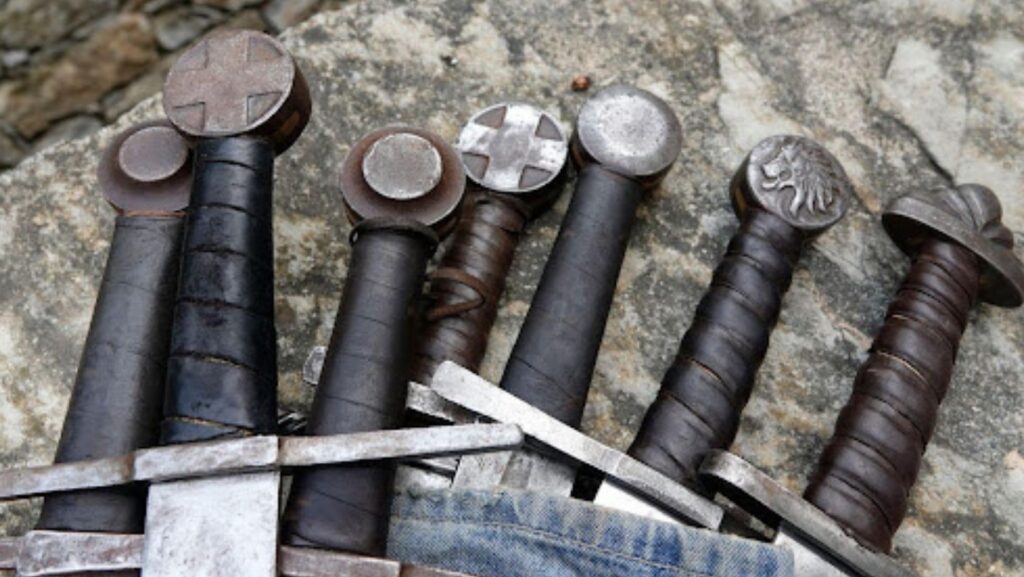
Modern buhurt swords require their design specifications to operate within a single engineering path. They must deliver decisive kinetic force against fully armored opponents while staying within strict safety envelopes defined by international rule sets. The design of these swords does not enable them to perform effective combat functions which involve cutting human targets or breaching protective body armor. Their design enables them to transfer momentum in a predictable way while withstanding multiple steel-on-steel collisions and maintaining control during periods of fatigue.
Medieval Extreme operates squarely in that space. Its swords reflect a production philosophy shaped by rule compliance (BI, WMFC, IMCF), biomechanical realities, and accumulated field data from competitive fighters. The result is a lineup where balance points, blade thickness, and steel treatment are not aesthetic choices, but variables tuned for measurable performance outcomes – stability and long-term durability under conditions.
Why Buhurt Swords Differ From Reenactment Weapons
Swords and reenactment weapons show initial similarity through their blunt edges and historical shapes and steel materials. The two weapons start to display their different characteristics. Reenactment weapons exist to create authentic visual displays while their users perform coordinated movements. Buhurt swords function as weapons which allow fighters to strike each other with full force during battles.
The Buhurt International rule set together with WMFC requires fighters to use swords which meet particular design specifications that include minimum blade thickness and maximum weight limits together with required edge radii specifications which protect against puncture injuries.
The design choices for the project include elements which reenactors find unacceptable because they require thicker spines and reduced distal taper and forward-biased mass which help to achieve scoring efficiency. Structural stability represents a safety necessity because it prevents weapon breakage and excessive flex which stop fights from continuing.
| Feature | Buhurt sword | Reenactment weapon |
| Blade thickness | 4-5 mm typical | Often 2.5-3 mm |
| Edge geometry | Rounded, energy-spreading | Thin blunt or lightly rolled |
| Heat treatment | Spring-tempered for impact cycles | Often cosmetic or light |
| Intended contact | Full-force steel-on-armor | Controlled, staged strikes |
| Failure tolerance | Must survive repeated collisions | Limited impact expectation |
The differences between the two training methods become evident through their demonstration in Training Longsword for Armored Combat. The product weighs 2.1 kilograms and its unrefined design contains fewer hardening points, which makes it less visually appealing but increases its operational lifespan. The research shows that training equipment fails first because of cyclic impact fatigue, which scientists proved through their studies in sports engineering.
Balance, Flexibility And Edge Geometry
Balance in buhurt involves fighter performance through their ability to accelerate and decelerate weight while maintaining their balance. The center of gravity determines whether a sword behaves as a controllable lever or a destabilizing pendulum during clinches and shield pressure.
The Falchion “Law” pushes this to the upper edge of allowed specifications. This device which weighs approximately 2.4 kg achieves scoring capability through its mass distribution while maintaining control through its inertia properties. This finding matches the results of biomechanical studies which investigate sports that involve striking techniques.
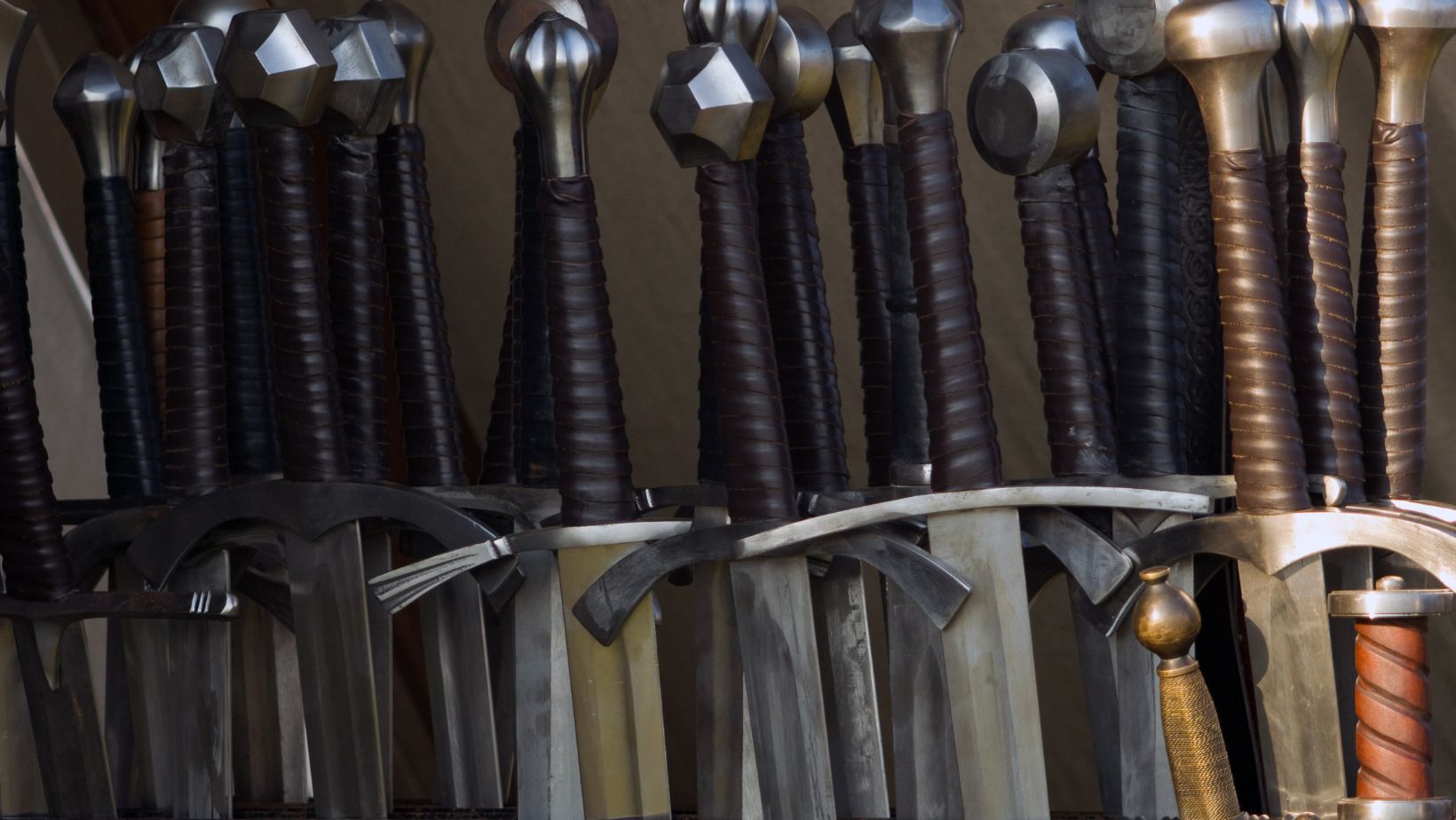
Flexibility and edge geometry complete the system:
- Spring steel tempering allows controlled flex that dissipates peak forces instead of rebounding unpredictably.
- Thicker edges (often 2-3 mm radius) spread contact forces over a larger area, reducing localized stress on armor and joints.
- Reduced distal taper increases blade stiffness, preventing “whip” effects that can cause unsafe rebounds.
The Zweihander 2.0 [5 mm] demonstrates how these parameters scale. The weapon maintains its stable performance and duel usability because it uses a 5 mm blade thickness and balances at 1 cm distance from the guard. The extended handle increases torque control, which allows operators to manage weapon length without losing their safety margins.
Common Myths About “Blunt Weapons”
The term “blunt” creates confusion because a buhurt sword requires no sharp edge to inflict harm through its weight and the hardness of its blade. Sports medicine research demonstrates that blunt force trauma represents the primary cause of injuries during armored combat which includes both concussive injuries and joint damage but not lacerations.
People continue to believe that heavier weapons result in more dangerous outcomes. The design of lightweight swords makes them dangerous because they move quickly while their blades hit objects with greater force. The design of heavier swords reduces injury risk because their blades hit surfaces with more predictable behavior.
People believe that achieving historical accuracy leads to unsafe outcomes. The design of late medieval weapons had a preference for thick spines and rounded edges because those elements provided better protection against armored opponents.
Training vs Tournament Swords
The training swords of Medieval Extreme are designed to endure 1000 strikes against various defense equipment because their construction materials are too strong and their essential parts need to withstand intense impact. The results show that industrial engineering impact tool tests show that softer components produce better results during repetitive stress tests compared to harder components.
The design of tournament swords meets specific performance requirements established by the competition rules. The Falchion “Law” and Zweihander 2.0 together with WMFC Pro-Fight Sword reach their maximum allowable weight and balance according to regulations because competitive advantage exists in that range. The exclusive use of these swords for training purposes leads to faster fatigue-related failures and higher safety hazards.
Modern buhurt kits should use swords as precise instruments because they function as specialized tools instead of common steel equipment. The product range from Medieval Extreme shows how modern armored combat requires engineers to combine safety and power and durability into their designs.