
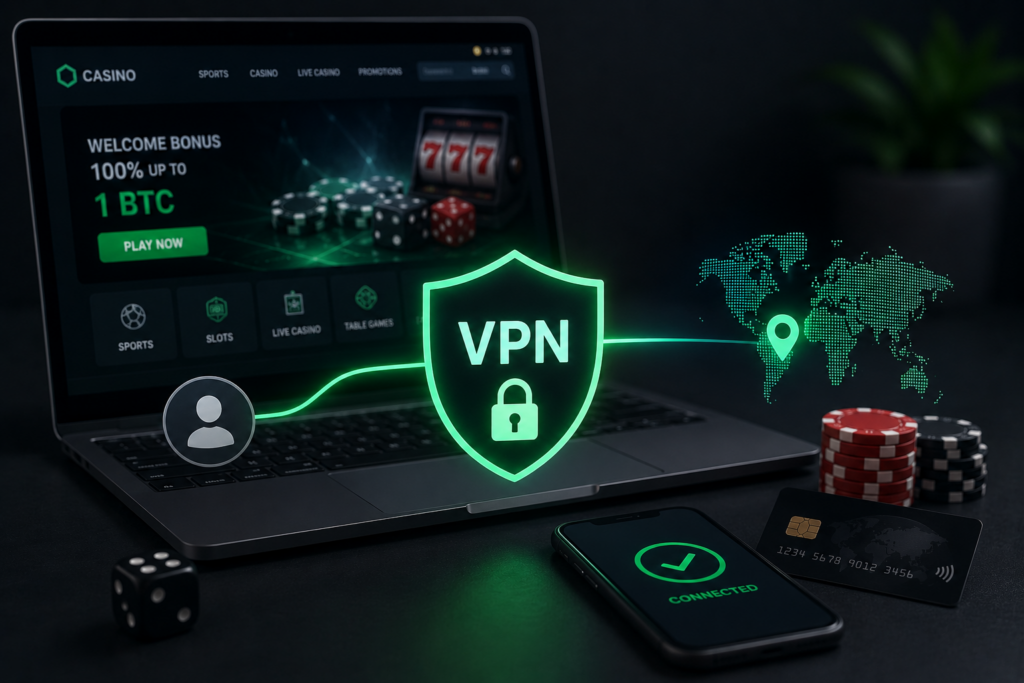
Most people install a VPN for one of three reasons: streaming libraries, public wifi paranoia, or working around a network block at the office. Almost nobody installs one thinking about online gambling access, and yet it’s become one of the biggest practical use cases for VPN software in 2026, quietly sitting behind millions of logins to platforms that would otherwise be geo-blocked entirely.
The tech behind this is straightforward. A VPN routes your traffic through a server in a different location, which means the site on the other end sees that location’s IP address instead of your real one. For streaming, that unlocks a different content library. For online gambling, it can unlock access to a platform that isn’t licensed to operate where you actually live, or that offers sharper pricing and lighter verification than whatever’s available domestically. Same mechanism, very different stakes.
Why “It Loaded” Isn’t the Same as “It’s Safe to Use”
Here’s where the tech reality gets more complicated than most VPN comparison articles bother to explain. A gambling site can load perfectly fine over a VPN connection and still treat that connection as a liability the moment your account becomes valuable. This is the gap between what actually gets tested in casual research and what a serious technical audit would catch: access at signup tells you almost nothing about what happens at withdrawal.
Plenty of platforms exist in a genuine grey zone. Their terms of service don’t explicitly mention VPN use, which means technically nothing is being violated, but that also means there’s no contractual protection if the operator later decides your VPN-routed session looks suspicious and treats a withdrawal request accordingly. That’s meaningfully different from a platform that states outright, in its own terms, that VPN access is permitted. One is a documented policy you can point to. The other is a gap the operator can fill in however’s convenient once you’re the one asking for money back.
The Detection Side Is More Sophisticated Than Just IP Checking
If you’re assuming a VPN alone makes your gambling activity invisible to a platform’s risk systems, that’s outdated thinking. Modern fraud and compliance stacks cross-reference more than just IP address. Browser fingerprinting, WebRTC leaks that can expose your real IP even while a VPN is active, device signals, payment method history, and behavioral patterns all feed into the same risk model. A VPN with weak leak protection can create the illusion of anonymity while quietly exposing the exact location data the VPN was supposed to hide, which is a worse outcome than not using one at all, because it creates a mismatch between your claimed location and your actual footprint that looks more suspicious to a risk engine than a clean, consistent connection would.
This matters even more for live, in-play betting specifically, where the extra network hop a VPN introduces has a real, measurable latency cost. Pre-match wagers don’t care about an extra 30 to 50 milliseconds. In-play markets absolutely do, and a slow or poorly routed VPN connection can mean the line moves before your bet slip even finishes loading. Anyone using a VPN for live betting specifically should be testing actual in-play performance, not just confirming the site loads, before relying on it for anything time-sensitive.
What a Real Access Audit Actually Looks Like
The honest way to evaluate whether a gambling platform is genuinely VPN friendly versus just VPN tolerated is the same methodology you’d apply to any access reliability test: repeat the connection across multiple providers, multiple exit countries, and multiple sessions over time, then track what actually happens at withdrawal rather than just at login. A platform that “works once” from a single test location tells you almost nothing useful. Stability across repeated, varied testing tells you something real.
That’s the exact gap https://vpncasinos.net/ built its scoring system to close, running VPN access as a weighted testing category alongside verification policy and transparency of the underlying account rules, rather than trusting a single homepage claim about being “VPN friendly.” The distinction between a platform that explicitly allows VPN access in its terms and one that simply hasn’t gotten around to blocking it yet sounds like a small technicality until the day your account becomes valuable enough for that difference to matter.
The Bigger Point Buried in All This
None of this is really about gambling specifically, it’s about a broader pattern in how privacy tools interact with platforms that have every incentive to treat your privacy as suspicious the moment you become profitable to them. A VPN is a genuinely useful piece of infrastructure. It is not, on its own, a guarantee that a platform on the other end will treat your access the same way at withdrawal as it did at signup. The tech does its job. Whether the platform on the receiving end plays fair with what that tech gives you is a completely separate question, and it’s the one almost nobody bothers to actually test before depositing anything real.