
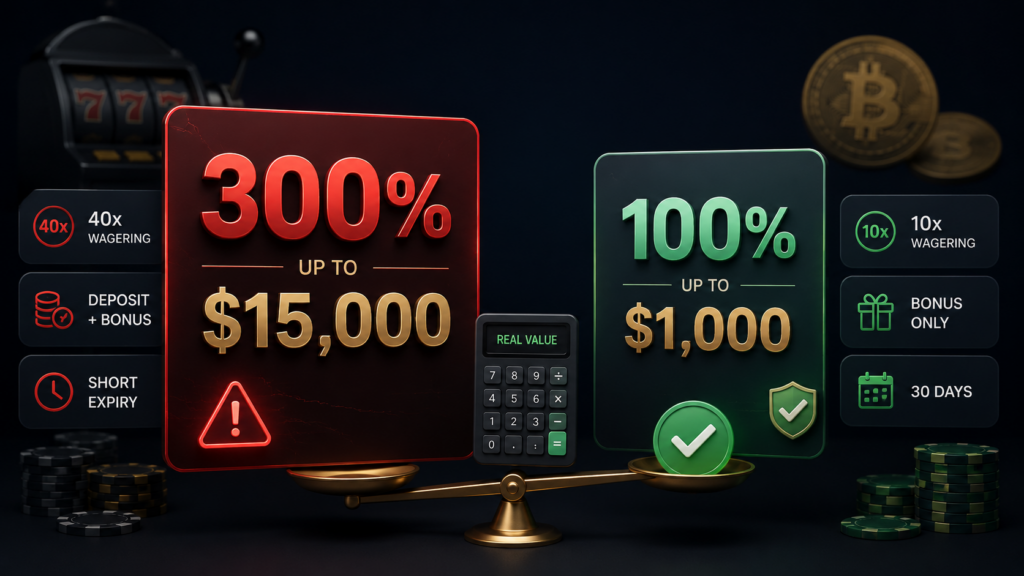
Marketing math and actual math are two different disciplines, and nowhere is that gap wider than on a crypto casino promo page. A “300% up to $15,000” banner looks objectively bigger than a “100% up to $1,000” banner sitting next to it. Run the actual numbers on rollover, game weighting, and expiry, and the smaller offer regularly comes out ahead. This isn’t a hot take, it’s arithmetic, and it’s worth walking through properly because most people never do the calculation before depositing.
What Is a Crypto Casino Bonus, Actually?
A crypto casino bonus is a match on a deposit, a free bet, a cashback percentage, or a free-spin package that gets added to a player’s balance, usually with conditions attached before any of it, or the winnings from it, can be withdrawn. The headline number is the part every casino wants you to see first. The conditions are the part that determines whether the headline number means anything at all.
The single biggest lever in that condition set is the wagering requirement, sometimes called rollover, the multiple of the bonus (or bonus plus deposit) you have to bet through before a withdrawal is possible.
How Does the Rollover Math Actually Work?
Take a $100 deposit matched at 100 percent with 40x wagering on the bonus alone. That’s $100 times 40, meaning $4,000 in total wagering volume before the bonus clears. Now take a $100 deposit matched at 300 percent, sounds incredible, but the terms apply the wagering multiplier to both the deposit and the bonus combined. That’s $100 plus $300 equals $400, times 40, equals $16,000 in required wagering. Same 40x multiplier, four times the actual grind, and the bigger headline number is the reason the requirement quietly quadrupled.
This is exactly the trap FreeCryptoBonus’s grading methodology is built to catch under its Hidden Restrictions category, which accounts for 20 percent of a bonus’s total score specifically because deposit-plus-bonus wagering is one of the most common ways a generous-looking offer turns into a treadmill. Rollover requirement itself carries the single largest weight in the scoring, 30 percent, precisely because it decides more often than any other factor whether a bonus is actually usable or just decoration on a signup page.
Why Do Some Massive Bonuses Score Worse Than Small Ones?
Because size is exactly one input out of seven in a properly built scoring model, and it’s weighted at only 10 percent. A five-figure bonus attached to 60x or 80x wagering, a tiny handful of eligible games, and a 48-hour expiry window can score lower than a modest offer with 10x wagering, broad game eligibility, and a 30-day window. The current standout example on FreeCryptoBonus’s own rankings is 500 Casino’s $500 free bet with 300 percent rakeback up to $15,000, which stands out specifically for its 1x rollover rather than the size of the headline figure. A 1x multiplier on a $500 free bet requires $500 in wagering total. Compare that to a bonus four times the size sitting at 40x, and the smaller offer clears in a single afternoon while the bigger one becomes a part-time obligation.
What Does Game Weighting Actually Do to a Bonus?
Here’s a variable most players never check until they’re already stuck. Slots typically count 100 percent toward a wagering requirement. Blackjack, roulette, and live dealer tables often count far less, sometimes 10 percent, sometimes 0. A player who claims a slots-heavy bonus and then wagers it through low house-edge table games can discover they’ve barely moved the needle on their actual requirement, despite genuinely playing through the nominal dollar amount several times over. This is the Eligible Games component of the scoring, worth 25 percent, and it’s arguably the second most important number on the entire page after rollover itself.
Are No-Deposit Bonuses Actually Worth Chasing?
Rarely, and the reasoning is worth spelling out rather than just accepting the warning at face value. A no-deposit bonus, free money with zero funding required, sounds like the platonic ideal of a promotion. In practice these routinely carry wagering requirements in the 50x-plus range, tiny maximum cashout caps, and restricted game lists, meaning the realistic expected value of clearing one is close to zero even before house edge enters the picture. A small-minimum-deposit welcome bonus with clean 10x to 20x terms almost always beats grinding through a no-deposit offer’s math, and it’s the reason serious bonus comparison sites treat no-deposit promotions as a completely separate, lower-priority category rather than the headline attraction.
What Should You Actually Check Before Claiming Anything?
Five numbers, in this order of importance. The wagering requirement, and specifically whether it applies to the bonus alone or the bonus plus deposit combined. The eligible games list, and whether your preferred game type counts at full weight. The expiry window, since anything under 15 days with meaningful wagering attached is functionally a countdown timer designed to expire before you clear it. The maximum cashout cap, since a bonus that limits your total withdrawal to 2x or 5x your deposit defeats the entire purpose of taking on variance in the first place. And the deposit method restriction, since some promotions quietly exclude the exact payment method you were planning to use, pushing you toward a higher-fee alternative instead.
FreeCryptoBonus runs every listed offer through exactly this seven-factor breakdown on a documented 100-point scale rather than ranking by headline size, which is the entire reason a boring-looking 100 percent match can legitimately outrank a flashy 300 percent one on the same page. The math doesn’t care which number looked bigger in the banner ad. It cares which one you can actually walk away with.