
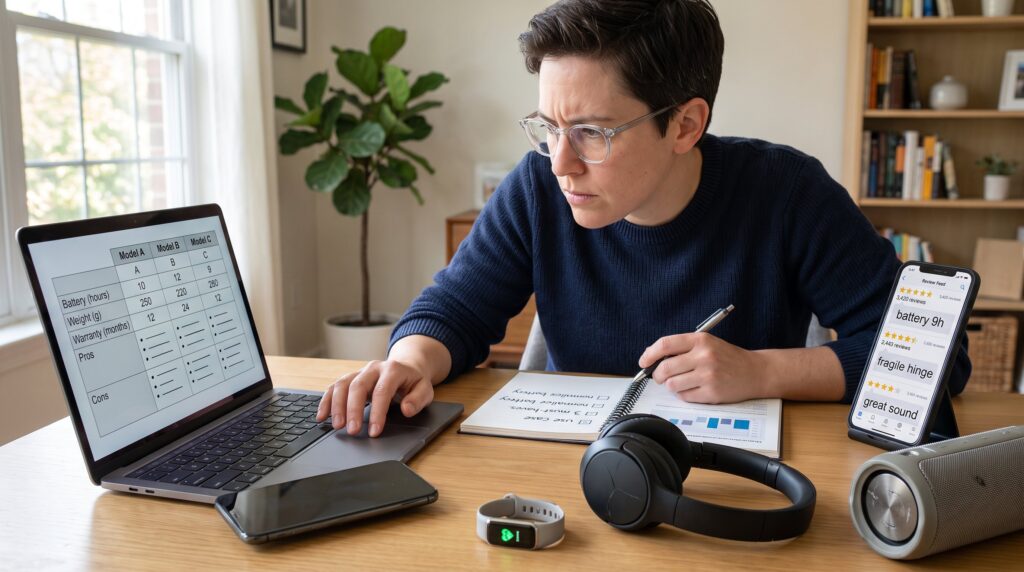
How to Compare Gadgets Using Online Reviews begins with a clear question: which device fits real daily needs, not marketing copy? Readers often face dozens of specs, a flood of star ratings, and a handful of extreme opinions. This guide shows practical steps to read reviews like data, spot patterns, and avoid traps such as fake praise or one-off failures. The approach balances quick heuristics for fast shoppers and deeper checks for people who want reliability over time.
Key Takeaways
- Using online reviews helps identify recurring strengths and weaknesses of gadgets beyond marketing claims.
- Define clear use cases and criteria to focus your gadget comparisons effectively.
- Normalize specs and prices across models to uncover real value and performance differences.
- Beware of review biases like selection bias and manipulation through repeated phrasing or sudden rating spikes.
- Build side-by-side comparison tables capturing price, specs, battery life, warranty, and review metrics for informed decisions.
- Treat reviews as data signals rather than absolute truths to reduce poor purchases and find gadgets fitting real-world needs.
Why Online Reviews Matter — What They Tell You (And What They Don’t)
Fact first: online reviews reveal recurring strengths, common failures, and real user satisfaction, but they rarely prove long-term durability or perfect fit for an individual.
Reviews matter because they collapse many personal experiences into visible patterns. For example, when 2,847 reviewers mention a headphone’s ear-cup cracking after six months, that signals a likely weak point more clearly than a single expert teardown. Reviews also reveal support and update behavior: dozens of comments about slow firmware fixes point to a vendor that deprioritizes maintenance.
What reviews reliably tell you:
- Recurring strengths and weaknesses (battery life, overheating, button failures).
- Real usage cases (remote work, commuting, gaming) through user stories.
- Customer service patterns, whether the brand honors warranty claims.
What reviews don’t fully tell you:
- Long-term durability beyond the most common failure window.
- How the gadget fits a very specific workflow or niche need.
- Absolute objective quality when sample sizes are small or skewed.
Practical warning: selection bias commonly inflates extremes. People report when angry or ecstatic: quiet content users rarely leave reviews. To compensate, focus on review count, recency, and repeated phrasing rather than single dramatic anecdotes. Readers can get more context from the resource guide.
Relevant reading on how comparison tools process review data appears on the site’s analysis of comparison tools, which explains why aggregated signals matter when judging patterns rather than individual claims.
Quick 5‑Step Framework For Comparing Gadgets Fast
Answer up front: use a repeatable five-step process that turns reviews into comparable signals.
-
Define the use case and three non-negotiable criteria. Specify whether the gadget is for daily commuting, remote work, or mobile photography, and pick measurable criteria like battery hours, weight in grams, and warranty months. This gives focus for scanning reviews.
-
Shortlist 2–4 plausible models that meet baseline specs and budget. Narrowing avoids analysis paralysis and makes comparison concrete.
-
Scan ratings, review counts, and recurring themes. Note average score, total reviews, and the ratio of 1–2 star to 4–5 star comments. Look for recurring words like “drops,” “lags,” or “excellent mic.” Quantify: how many recent reviews mention the same issue?
-
Normalize data. Convert battery claims to the same activity (video playback hours), compare per-unit price (price divided by key spec), and list warranty length in months. Normalized metrics reveal real value.
-
Build a side‑by‑side table highlighting differences in plain numbers and three top pros/cons for each model.
Practical illustration: a buyer compared three fitness bands by converting battery claims to hours at continuous heart-rate monitoring and discovered the mid-priced band actually offered 18% more real-world battery life than the flagship model. That made the purchase decision obvious.
For tools that automate parts of this workflow, Hyperlogic’s coverage explains how to browse related categories like games and software on the site: see the short guide to browsing coverage.
Side‑By‑Side Comparison Checklist (Actionable Items To Use Now)
Key action first: capture the same six data points for every gadget and compare them in a table.
Checklist items to record for each model:
- Price: list price and typical street price (note date collected). Convert to same currency if needed.
- Core specs: processor, RAM, storage, weight, and screen size, the exact numbers.
- Battery life: documented claim and two user-reported values (e.g., 12 hours claimed: 9 and 10 from reviewers under similar use).
- Warranty and support: warranty months and number of reviews mentioning successful support interactions.
- Review metrics: average rating, total review count, percent of 1–2 star reviews, and distribution by date.
- Recurring themes: two main pros and two main cons distilled into one-line phrases.
Example table row (condensed):
- Model A | $249 list / $199 street | 8GB RAM, 128GB | 14h claimed / 11h avg | 12-month warranty | 4.3★ (3,420 reviews) | Pros: loud speaker: Cons: fragile hinge.
How to gather these values rapidly:
- Use filter by “most recent” to spot regressions after firmware updates.
- Search reviews for concrete measurements (“X hours”,”Y grams”) and count occurrences.
- Note reviewer context (commute, gym, office) to match your use case.
Practical warning: don’t equate higher average rating with superior quality when review counts differ drastically. A 4.6★ product with 80 reviews is riskier than a 4.3★ model with 10,000 reviews.
If a reviewer repeatedly reports identical phrasing across multiple posts, treat it as a red flag for coordinated content and deprioritize that evidence.
Common Pitfalls, Biases, And Red Flags In Reviews
Straight answer: several predictable biases and manipulations appear in review datasets: spotting them saves bad purchases.
Common pitfalls to watch for:
- Selection bias: dissatisfied buyers are more likely to post, skewing negative signals. Counter by checking distribution over time and average rating trends.
- Recency bias: recent firmware or hardware revisions can change product behavior: prioritize reviews from after major updates or hardware revisions.
- Volume bias: low review counts amplify noise: treat small samples cautiously.
Red flags that indicate manipulation or low-quality evidence:
- Repeated phrasing across different accounts (word-for-word sentences).
- Sudden spikes of five-star reviews concentrated in a short window without varied language.
- Reviewer profiles with only one product reviewed or a pattern of promotional language.
- Generic praise or complaint with no specifics (no numbers, no scenario).
Concrete example: one smartwatch listing showed 1,900 five-star reviews over three days with near-identical wording about battery life. That pattern correlated with a promotional campaign and later collapsed when independent reviewers reported 20–30% lower battery performance.
Practical defenses:
- Cross-check claims against published teardown reports or reputable outlets. The Verge’s buying guides often verify hands-on metrics and can confirm or refute seller claims, making them useful for confirmation when a specific measurement is disputed.
- Read a mix of short and long reviews: short ones often signal emotion, long ones provide test conditions and numbers.
Honest lesson: the author once bought a Bluetooth speaker based on a swarm of glowing short reviews and learned it stopped pairing after three weeks, a costly reminder to weigh detailed reports more heavily than aggregate star ratings.
For ecosystem and accessory context that affects long-term value, Hyperlogic’s piece on mobile updates explains how platform support changes device longevity.
Conclusion
Final insight: treat reviews as signals, not verdicts. A repeatable, data-driven checklist reveals patterns that single opinions hide. Readers who normalize specs, check review distributions, and watch for manipulation steadily reduce costly mistakes and buy devices that fit real life.
For broader context on gadget reporting and aggregated coverage, readers may find the site’s overview of gadget and software coverage helpful to connect review reading with ongoing product trends.